Title (title large)

MSW Program Courses and Program of Study

Content

As a fully online student, you will be automatically registered each semester for your courses based on your program of study that follows the prescribed course scheduling pathway, unless otherwise approved by your Program Manager. For your first semester, you will be registered for 3 courses (two options, dependent on the course carousel found on page 17) for a total of 9 credits:

  1. SW 630 SW History & Social Welfare Policy (1st 7-weeks)
  2. SW 610 Structural Oppression (14-weeks)
  3. SW 623 Methods with Organizations, Communities and Legislatures (2nd 7-weeks)
  • OR
  1. SW 611 Theoretical Perspectives on Human Behavior (1st 7-weeks)
  2. SW 620 SW Methods: Individuals (14-weeks)
  3. SW 640 Elements of Evidence Informed Practice (2nd 7-weeks)
Foundation
Semester 1 or 2

SW 640 Elements of Evidence Informed Practice (3 credits) 2nd 7-week course

SW 611 Theoretical Perspectives on Human Behavior (3 credits) 1st 7-week course

SW 620 SW Methods: Individuals (3 credits) 14-week course

Semester 1 or 2

SW 630 SW History & Social Welfare Policy (3 credits) 1st 7-week course

SW 623 Methods w/ Orgs, Communities & Legislatures (3 credits) 2nd 7-week course

SW 610 Structural Oppression I (3 credits) 14-week coursea

Semester 3

SW 624 SW Methods w/ Couples and Families (3 credits) 14-week course

SW 680 Foundation Practicum I (3 credits) 14-week course

Semester 4

SW 621 SW Methods with Groups (3 credits) 14-week course

SW 681 Foundation Practicum II (3 credits) 14-week course

Concentration
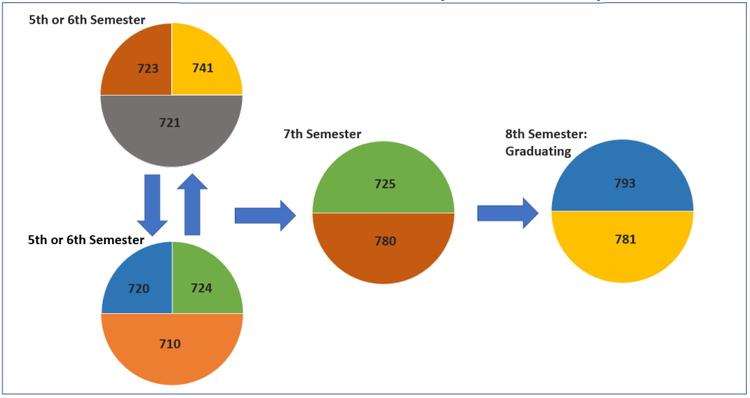
Semester 5 or 6

SW 723 SW Administration I (3 credits) 1st 7-week course

SW 741 Practice & Program Evaluation (3 credits) 2nd 7-week course

SW 721 Intervention Approaches with Groups (3 credits) 14-week course

Semester 5 or 6

SW 720 Intervention Approaches with Individuals (3 credits) 1st 7-week course

SW 724 Therapeutic Interventions with Families (3 credits) 2nd 7-week course

SW 710 Advanced Multi-dimensional Assessment (3 credits) 14-week course

Semester 7

SW 725 SW Administration II (3 credits) 14-week course

SW 780 Advanced Practicum I (3 credits) 14-week course

Semester 8

SW 793 Culminating Project (3 credits) 14-week course

SW 781 Advanced Practicum II (3 credits) 14-week course

Content
Foundational Coursework (first 4 semesters)

Content
Concentration Coursework (last 4 semesters)

Content

Use this table to help you plan your progression through the program. Course descriptions are available in

the MSW Student Handbook.

Content
Total: 60 Credit hours and 900 Internship hours
Title (title large)

Course Requirements

Content
To satisfy graduation requirements for the Traditional Standing MSW program, students must successfully complete 20 courses for a total of 60 credits of specialized curriculum and 900 hours of Field Education. 18 Transfer credits from another institution are not allowed in the MSW program. Students can complete the program in eight semesters by following a prescribed course offering schedule (program of study) that varies based on the semester of entry to the program (e.g., Spring, Summer or Fall). Students are expected to maintain continuous enrollment in the program. Students who deviate from the cohort program of study may find themselves having to wait to take courses to ensure that they continue to take courses in the correct sequence. Students who will not be attending a semester, must follow the leave absence procedure of page 20. During the 8 semesters of the program, semesters 1, 2, 5 and 6 include 3 courses each, while semesters 3, 4, 7 and 8 include 2 courses each, allowing concentrated time for field education. To participate in field education, students are responsible for finding their own site and field instructor. Detailed information on field education is provided on page 21 of this Welcome Packet.
Title (title large)

Online Academic Calendar

Content

UNR’s online Master of Social Work, traditional standing, requires eight 14-week semesters to complete.

Each semester may include 7 and 14-week courses. Please pay close attention to semester dates and

deadlines as you progress in the program and regularly check the Online Academic Calendar. The link can

also be found in the Student Resource Center. It is critical that you check this calendar regularly.

It is the student’s responsibility to familiarize themselves with the important semester dates on the Online Academic Calendar website every semester.

Title (title large)

MSW Student Handbook

Content
The MSW Student Handbook is an important document and provides detailed information about the School of Social Work and policies specific to the graduate online MSW program. The handbook includes information on program competencies, program of study, timeline for degree completion, advising, the Social Work Graduate Student Association, course descriptions, grievances, scholarships and more. Fully online students must review these policies and expectations and refer to them as needed throughout the program.
Title (title extra large)

Program Policies and Procedures

Title (title large)

Course Registrations

Content
Registration begins approximately 6 weeks prior to the semester start (you are automatically registered for courses each term). Students are to log into MyNevada to confirm course registration and pay semester bill. For course schedule problems, please contact your Program Manager immediately. Students with registration holds on their account will not be registered until all holds are removed. Holds can be placed for several reasons, including fees, and other unmet requirements. Any holds on your account are clearly indicated in MyNevada. To see if you have a hold that is preventing you from being enrolled in classes, navigate to MyNevada and type in ‘holds' in the search bar.
Title (title large)

Course Registrations

Content
Registration begins approximately 6 weeks prior to the semester start (you are automatically registered for courses each term). Students are to log into MyNevada to confirm course registration and pay semester bill. For course schedule problems, please contact your Program Manager immediately. Students with registration holds on their account will not be registered until all holds are removed. Holds can be placed for several reasons, including fees, and other unmet requirements. Any holds on your account are clearly indicated in MyNevada. To see if you have a hold that is preventing you from being enrolled in classes, navigate to MyNevada and type in ‘holds' in the search bar.
Title (title large)

Attendance and Syllabus Agreement

Content
Students are required to confirm their attendance in each course by Wednesday of Week 1. To confirm your attendance in each of your courses, you must complete the Attendance and Syllabus Agreement, which is located within the Modules section of each course. If you do not complete this agreement, the instructor will notify program administrators to determine if you should be withdrawn from the course. If you have any questions, please contact the instructor for clarification. For additional information, please refer to the New Student Orientation.
Title (title large)

Course Grades and Academic Probation

Content

Each graduate course must be completed with a grade of "C" or better for the credit to be acceptable toward an advanced degree. The probation policy for students who have a GPA below 3.0 at the end of any semester can be found at https://www.unr.edu/grad/student-resources/academic-standing.

In addition, students must maintain good standing with an overall cumulative graduate credit GPA of at least 3.0 on a scale of 4.0. Students must have a minimum GPA of 3.0 to meet graduation eligibility. If a course is not passed with a grade of C or higher, students must repeat the course, which could lengthen the program beyond six-, seven-, or eight-semesters, due to course offerings in a particular semester. Remember, the Graduate School policy requires all degree requirements must be completed within six years.

Title (title medium)

Course Grading Scale

Grade
%
A
93% - 100%
A-
90% - 92.9%
B+
87% - 89.9%
B
84% - 86.9%
B-
80% - 83.9%
C+
77% - 79.9%
C
74% - 76.9%
C-
70% - 73.9%
D+
67% - 69.9%
D
64% - 66.9%
D-
60% - 63.9%
Title (title extra large)

Dropping a Class or Withdrawing from the Program

Content
Students who wish to drop or withdraw from a course(s) are required to consult with the Olga Martinez to discuss their options prior to the drop or withdrawal deadline. After speaking with the Olga, students must email Olga (from their UNR email address) with their request. Students who leave the University without officially withdrawing receive a failing grade in all courses. The drop and withdrawal deadlines are located within WebCampus as well as the Online Academic Calendar.
Title (title large)

Grade Appeal Policy

Content
The School of Social Work adheres to the University’s policy by which students may appeal a grade. There are important guidelines outlined in the MSW Student Handbook.
Title (title large)

Dismissal Policy

Content
The School of Social Work adheres to the Dismissal Policy of the Nevada System of Higher Education (NSHE) Code, Title 2, Chapter 11.
Title (title large)

Leave of Absence Policy

Content

A leave of absence is a temporary cessation of study and usually approved for one or two consecutive semesters. Leaves of absence may be taken for a maximum of one year. Students requesting a leave of absence must be in good academic standing and submit a completed form, “Request for a Leave of Absence,” to the Graduate School before the period of leave begins. Time spent on an approved leave is included in the time allowed to complete the degree. New students cannot take a leave of absence during their first semester. Eligible students who take a leave of absence are not required to reapply for admission or pay a reapplication fee and will have the opportunity to register/enroll with continuing students for the semester in which they intend to return to the University.

Note that degree-seeking students who leave the University without a degree or an approved leave of absence must undergo formal readmission to the University. Please contact the MSW program advisor (Olga Martinez) via email at omartinez@unr.edu if a need to take a leave of absence arises. The MSW Student Handbook covers this topic in more detail. Please be aware that there are deadlines for a leave of absence request. The specific leave of absence deadlines are located within WebCampus as well as the Online Academic Calendar.

Title (title large)

Code of Conduct

Content
The School of Social Work adheres to the University of Nevada, Reno “Academic Standards Policy for Students” concerning issues of academic integrity. Please visit the website for a complete description, definitions and policies regarding class conduct and academic dishonesty.
Title (title large)

Diversity, Equity, and Inclusion

Content
The UNR School of Social Work is committed to maintaining a safe, inclusive environment for all students. We uphold the values of diversity, equity and inclusion in our academic courses, field work and general discourse with one another. We reject discrimination based on, but not to limited to, race, ethnicity, culture, gender identity and expression, sexual orientation, age, ability and disability, socioeconomic status, religion, and political perspectives. We expect students, faculty and staff will learn from one another as they share from their diverse, lived experiences. We encourage students to practice a culture of curiosity, respect and self-reflection as they establish a professional identity founded upon the values of the NASW Code of Ethics
Title (title extra large)

Field Education/Practicum

Content

MSW students must complete a total of 900 hours of field education during SW 680 and SW 681, SW 780 and 781 Practicum courses. All students will participate in the Field Education Resource Centers (Pre-Placement Orientation) during their first and fifth semesters. Yezenia Olivera, Field Education Program Assistant Coordinator, will be the facilitator for the pre-placement orientation as well as the main point of contact for your field placement questions. Through the pre-placement orientation, Yezenia will provide detailed information related to searching for agencies, field instructor qualifications, key learning outcomes, and how to prepare for your field education interview. The Field Education Office wants to ensure that every online MSW student is successful in locating, securing, and retaining a quality field placement that will allow for practice opportunities to integrate theory and classroom knowledge with real-world cases within your placement agency. To meet the 900-hour field experience hours, students complete approximately 16 hours of field education per week for 14 weeks during the four semesters. It is the student’s responsibility that all hours are to be completed by the end of the 14 weeks. Additionally, students participate in a weekly seminar that structures learning activities that will help students integrate theory and practice skills gained from academic course work with authentic field experiences.

Please note that remote students (those who reside outside a 60-mile radius of UNR) are responsible for finding their own practicum placements

Title (title large)

Field Studies Resource Center

Content
As a new student, you will be enrolled in the Field Education Resource Centers (FERC) during week 6 of your first (Foundation) and fifth (Concentration) semester. The Field Education Resource Center was developed to orient students to the field education process and requirements. Field education is a central component of the MSW degree, and the placement process for online students differs from the traditional campus program. These Resource Centers will walk you through the placement process, from the Field Application to agency contacts and interviews, preparing for your internship prior to the start of the semester, and everything in between.
Title (title large)

Field Experience FAQ’s

Title (title medium)

About Field

Title (title medium)

Why is field education required for my degree?

Content
Field education is the "signature pedagogy" of social work education and affords you the opportunity to actively observe and experience social work practice, reflect on your experience, construct personal practice guidelines, and then practice these in a guided field setting experience while being supervised. The success of field education is dependent on the extent to which you are able to translate and synthesize material from the classroom setting to the field setting.
Title (title medium)

What is the difference in field education for MSW Foundation and MSW Concentration students?

Content
MSW Foundation students experience field at the foundation, or Generalist Practice level, learning to act as professional social workers, conducting research-informed practice and practice-informed research, engaging in policy practice, and learning how to assess, intervene, evaluate, and engage with diverse individuals, families, groups, communities, and organizations. MSW Concentration students 23 move to the Advanced Generalist practice level and are expected to demonstrate autonomy, leadership, and the ability to and solve more complex problems in their field placements.
Title (title medium)

Pre-placement Process

Title (title medium)

How will I prepare for the field education experience?

Content
During the second half of your first semester in the MSW program, you will be enrolled in the Field Education Resource Center where you will complete the steps to prepare for your internship under the guidance of staff from the UNR Social Work Field Education Office. These preparations continue throughout your second semester in the MSW program.
Title (title medium)

In what types of settings can I complete my field hours?

Content
There are many options for both traditional and non-traditional field placements outside of agencies that have historically employed social workers (i.e. child welfare, clinical settings, and non-profit agencies). Students interested in non-traditional settings should discuss these opportunities with the Field Education office.
Title (title medium)

Can I do my field placement at my current job?

Content
Not in your current position, but maybe with your current employer. Field placements completed at a student's place of employment must be approved in advance, and the duties, hours, and supervisor must be different than the everyday employment duties. The field experience must provide the student with specific social work practice opportunities that are aligned with the social work competencies outlined in the Field Learning Plan.
Title (title medium)

Can I choose any "concentration" for my field placement?

Content
No. The UNR School of Social Work focus is on Generalist & Advanced Generalist Practice. Generalist practitioners creatively and effectively employ a range of prevention and intervention strategies to enhance social functioning at all system levels. While some placements may be more heavily concentrated on micro, mezzo, or macro work, you will be provided with and are expected to engage in practice opportunities that allow you to practice and master all nine required social work competencies.
Title (title medium)

Will the Field Education Office ensure I secure a field placement?

Content
No. There is no guarantee that you will secure and retain a field placement. The Field Education Office will facilitate the process and help you to identify agencies to interview with, but it is ultimately your responsibility to contact the agencies to arrange interviews and to perform well in the interview. For students who reside locally in the Reno area, the field office will facilitate the field placement process.
Title (title medium)

Are there paid internships available?

Content
Not usually, internship stipends for field students are extremely rare. Few agencies have the budget to provide stipends, but when available, they are permissible. The Field Education Office must be notified if a stipend is offered, and the arrangement must be formally agreed upon by the agency, student, and University via the Organization Agreement. The School of Social Work is not currently offering any stipend opportunities.
Title (title medium)

Will my financial aid or VA benefits be impacted if I do not secure a field placement?

Content
Possibly. Students receiving financial aid or VA benefits who are unable to secure a field placement should be vigilant of the University drop dates at the beginning of the semester, as in some cases, students must drop or withdraw from the course if they are unable to locate a placement.
Title (title medium)

What should I do if I have a criminal conviction or another issue in my background that

I think might affect my placement?

Content
You may choose to disclose this in your Field Application and discuss the matter with the Field Education Office during the pre-placement process so that a plan may be made for where you are sent to interview. Once placed, you should be prepared to complete all required training and be satisfactorily screened for any pre-placement background or health checks required by your field agency. In many cases, background checks are accompanied by sworn disclosure statements that require disclosure of charges and convictions. If you are impacted by such an issue in your placement, the Field Education Office may be able to offer some support and assistance, but ultimately you must be able to secure a placement. If you are unable to secure a placement for this reason or incur a new charge or conviction after you are placed, you may be subject to the Remediation Policy.
Title (title medium)

How should I prepare for field if I am a student with a disability?

Content
Students with disabilities should contact the Disability Resource Center well in advance of the start of their field placement and once confirmed with the Center, are advised to work with the Field Education Office to identify and discuss needed accommodations to ensure they are in place prior to starting placement. Please note that accommodations cannot be made retroactively but students may request accommodations as soon as they learn of a disability (which may occur at any time during the field experience).
Title (title medium)

When will my placement be confirmed?

Content
Please refer to the placement process calendar in the Field Education section of the SRC. Your first step is to submit your Field Application and resume. Once that is approved, you can start contacting agencies to arrange interviews.
Title (title medium)

What if my placement is confirmed, but then agency becomes unavailable to students

before I start field?

Content
In some unfortunate cases, students have been confirmed in a placement when the Field Education Office is notified by the agency that they are now unable to accept that student. In this case, the Field Education Office will assist you in locating a new placement, but you should be aware that this is a possibility for any placement, and you should have a backup plan for alternatives if a placement cannot be located. Drop and withdrawal may be required, so it is helpful to have a plan in mind to address lost credits or the impact this might have on financial aid.
Title (title medium)

Field Education Courses (SW 680/681 and SW 780/781)

Title (title medium)

When do I begin my Field Education Course?

Content
Students following a regular full-time MSW program schedule will begin SW 680 or SW 780 at the beginning of their third semester, depending on their level as Foundation or Advanced Standing students.
Title (title medium)

How many hours of field do I have to complete?

Content
You must complete a total of 450 hours over two semesters (225 per semester) to meet the field education requirement for each academic year. An MSW Foundation student will complete a total of 900 hours (450 in the Foundation year and 450 in the Concentration year). An Advanced Standing MSW Concentration student will complete 450 total hours.
Title (title medium)

How do I track and report my field hours?

Content
You will submit the Field Time Logs to your Faculty Liaison as assigned. Field time logs capture both the current and cumulative total of hours you have spent in the field setting each week and link your field activities back to your required social work competencies, in an effort to keep learning goals at the forefront of your experience.
Title (title medium)

What is the Field Learning Plan?

Content
The Field Learning Plan outlines how practice opportunities are provided for you to demonstrate the identified core competencies and practice behaviors of your Foundation or Concentration year that are mandated by the Council on Social Work Education.
Title (title medium)

How am I evaluated by my Field Instructor?

Content
At the end of each field semester, your Field Instructor will complete the Assessment of Student Practicum Field Performance to provide input to you and your Faculty Liaison about your performance according to the competencies and practice behaviors and within the context of the current semester
Title (title medium)

Will I receive a letter grade for the field education courses?

Content
No. You will receive a grade of Satisfactory or Unsatisfactory. It is possible to fail the field course if you are not able to effectively demonstrate the skills, knowledge, and values for every competency and/or you do not submit the required course assignments throughout the semester. In some cases, students must drop or withdraw from the course if they are unable to locate a placement.
Title (title extra large)

Support Resources

Content
As a UNR student, you have access to a variety of services that can help you at no additional cost. Just remember, all you must do is ask for help if you need it. UNR offers services to assist students in successful academic achievement, including:
Title (title large)

Technical Support

Content

You have a Technical Support team that is available to you 24 hours a day, seven days a week, every day of the year. You can contact Technical Support by phone, email, or chat. There is also an online Frequently Asked Questions page where you quickly can find answers to our most asked questions. Visit the Technical Support page for more information.

Phone (toll-free): 888.896.7604 (Option 1)

Website: http://unr.echelp.org

Title (title large)

Technical Support

Content

You have a Technical Support team that is available to you 24 hours a day, seven days a week, every day of the year. You can contact Technical Support by phone, email, or chat. There is also an online Frequently Asked Questions page where you quickly can find answers to our most asked questions. Visit the Technical Support page for more information.

Phone (toll-free): 888.896.7604 (Option 1)

Website: http://unr.echelp.org

Title (title large)

Office of Financial Aid and Scholarships

Content

The Office of Student Financial Aid & Scholarships aims to help make a university education more affordable. To request Financial Aid, students must first submit the Free Application for Federal Student Aid (FAFSA). For those students who submitted the Free Application for Federal Student Aid (FAFSA) will be sent an FA Offer Email to the MyNevada preferred email address. The details of the financial aid offer email will also be found in the MyNevada student center dashboard in the Communication Center link under Completed Communications. Be sure to add finaid@unr.edu to your safe sender or contacts to improve the timeliness of receiving these important email messages.

If you need assistance regarding information on ways to pay for education, types of federal and private aid options, including aid programs for your specific school, please contact the Financial Aid office.

Financial Aid Office

Phone: (775) 784-4666

Email: finaid@unr.edu

Zoom virtual front desk

You will find information on the School of Social Work scholarships available for students on our website: School of Social Work Scholarships. For more information on general university scholarships/financial aid please visit Student Financial Aid & Scholarships. Additional School of Social Work scholarships can be found in the MSW Student Handbook.

Title (title large)

Writing Center

Content

As a University of Nevada, Reno student, you have access to the free consultation services at the University Writing and Speaking Center. The professionals at the center offer consultations for;

  • Writers at all levels
  • Work at any stage of writing from development to completion
  • Academic, professional, personal, community, and creative projects
  • Written, visual, oral, digital, and mixed media texts

Students may make an appointment for a 45-minute in-person or online consultation. Asynchronous support will provide marginal comments and an overall letter of feedback and synchronous support will have options for chat only or video real-time discussions.

Title (title large)

Cashier’s Office

Content

The Cashier's Office is responsible for student fee assessment and collection, distribution of related fees, generation of 1098-T Tuition Statements for qualified tuition and related expenses, and the refunding of credit balances. Throughout your time at the University, you will receive emails from the Cashier’s Office, letting you know of new statements among other items. You can learn more about payment plans, financial holds, and more here: Cashier’s Office FAQ

Cashier's Office

Website: Cashier's Office | Campus Business

Phone: (775) 784-6915

Fax: (775) 327-2296

Email: cashiersoffice@unr.edu

Title (title large)

Cashier’s Office

Content

The Cashier's Office is responsible for student fee assessment and collection, distribution of related fees, generation of 1098-T Tuition Statements for qualified tuition and related expenses, and the refunding of credit balances. Throughout your time at the University, you will receive emails from the Cashier’s Office, letting you know of new statements among other items. You can learn more about payment plans, financial holds, and more here: Cashier’s Office FAQ

Cashier's Office

Website: Cashier's Office | Campus Business

Phone: (775) 784-6915

Fax: (775) 327-2296

Email: cashiersoffice@unr.edu

Title (title large)

University Library

Content

As a University of Nevada, Reno student, you have access to the UNR libraries. Online collections of magazines, newspapers, journal articles, research guides, books, microfilms, video tapes, audio CDs are among the many services available at the Mathewson-IGT Knowledge Center and the four science libraries. To learn more, please visit University Libraries.

We encourage our graduate students to utilize our electronic databases to complete writing assignments and to advance their research initiatives. Our library has a commendable number of electronic resources to complete academic work that expand the scholarship of our profession in educational leadership.

Having difficulties navigating the library? You can find helpful tips at Quick How-Tos. For specific questions not answered in the library guides, please contact the library at (775) 784-4636.

Title (title large)

Nevada Wolf Shop

Content

Order your textbooks each term using the Nevada Wolf Shop or a vendor of your choice. Additionally,

you can purchase your UNR gear and wear it proudly as a graduate student here: Nevada Wolf Shop.

Title (title large)

Veteran Services

Content

The Veteran Services Office is your liaison to the U.S. Department of Veterans Affairs for veteran and

veteran related education benefits. Here are just some of the services they provide:

  • Weekly email listserv reminders
  • Preventative at-risk eligibility notifications
  • Benefit advising and tips to maximize their potential
  • Enrollment certification submissions to the Veteran Affairs Education Benefits Office
  • Collaborative programming opportunities for academic, personal, and professional development

For more information, please visit Veteran Services.

Title (title large)

Disability Resource Center

Content
The Disability Resource Center (DRC) offers a wide range of support services and accommodations for all undergraduate and graduate students with disabilities. Students are encouraged to contact the UNR 28 Disability Resource Center at (775) 784-6000 to access a range of supportive services. Accommodations for all reasonable requests will be made for documented disabling conditions. More information is located on the Disability Resource Center website. Note that students must contact the DRC if they need special accommodations for courses; the DRC will issue appropriate letters and distribute them to the faculty in the students’ courses. It is the student’s responsibility to contact the DRC for this help.