What Social Workers Can and Can’t Do

It takes only a brief review of the historic accomplishments of social workers to understand the vital nature of the profession. Social workers have been at the forefront of advocating for civil rights, ensuring that individuals with mental illness receive humane treatment, and addressing issues such as abuse and neglect. In serving the vulnerable and oppressed, social workers have been doing groundbreaking work for more than a century.
The extensive reach of the profession brings social workers into many segments of society. Working in schools, health care facilities, government agencies, corrections and even the military, social workers apply their expertise to a variety of issues.
In any setting where social workers practice, they need to be well versed regarding their unique roles and any professional boundaries on those roles. Broadly speaking, the scope of what social workers can and can’t do is outlined in their code of ethics, and in federal and state laws and regulations.
Aspiring social workers can benefit from learning about the boundaries of working in the field so that they can maximize their effectiveness and protect the rights of the individuals they serve.
Social Worker Job Description
The purpose of social work is to improve the lives of individuals and ensure that their needs are met. Often focused on people who are oppressed, living in poverty or otherwise vulnerable, a social worker’s responsibilities encompass a wide range of areas.
How Social Workers Carry Out Their Role
The social worker job description generally centers on connecting vulnerable individuals, families and communities with the specific resources they need. To do that, social workers follow various social work process models. Although individual models differ, they generally include three stages:
- In this stage, a social worker engages with the client, analyzing relevant information and developing a plan of action.
- In this stage, a social worker creates a plan of action (or intervention method).
- In this critical stage, a social worker ensures that the intervention method is still relevant and appropriate.
The Client Populations That Social Workers Serve
Social workers help a diverse array of client populations, including:
- Children and families
- Older adults
- People in the corrections system
- People in the health care system
- People with mental health or substance use disorders
- Students
The Issues That Social Workers Help Address
The parameters of social work encompass a wide range of issues. The particular subfield of social work and the client population they work with dictates exactly what social workers do. The following examples demonstrate the breadth of their work:
- Helping older adults maintain their health and a stable lifestyle
- Ensuring that children live in safe homes
- Working with students in schools to address issues such as bullying
- Helping people who are coming out of the correctional system find rehabilitation services
- Ensuring that people with disabilities have the resources they need and that their legal rights are protected
- Working with patients in health care facilities to connect them with services
- Providing counseling to clients with mental health or substance use issues
- Helping homeless individuals find shelter
Social Workers’ Obligations in Advocacy
In addition to working directly with clients and addressing specific issues, social workers have a broader obligation to advocate for basic rights. This can involve:
- Engaging in political action to ensure that all individuals and communities have equal access to resources and opportunities
- Working to expand opportunities for all individuals and communities, particularly for those who are disadvantaged, oppressed or vulnerable, or who have been exploited
- Promoting respect for social and cultural diversity
- Acting to end the discrimination, exploitation or domination of any individual or group
Social Workers’ Role in Program and Policy Development
Social workers may also have the opportunity to make a difference on a macro level by developing programs and policies to improve the lives of vulnerable individuals and groups.
- Developing new programs enables social workers to apply their expertise in building consensus for new programs, establishing goals and structures for these programs, crafting program budgets, and bringing together community resources in support of new programs.
- Developing policy enables social workers to use their skills at the local, state and federal levels to help form policy and draft legislation that promotes the well-being of vulnerable populations. This work can even lead to new careers as policy analysts or policy advisors.
What Social Workers Can and Can’t Do
The code of ethics of the National Association of Social Workers (NASW), along with federal and state laws and regulations, outlines the scope of the social work profession. These parameters provide an understanding of the actions social workers are permitted to take — as well as several they are not.
What Social Workers Can Do
The scope of what social workers can do includes a range of actions, as the examples below demonstrate.
Protect Client Confidentiality
Protecting a client’s confidentiality is a cornerstone of developing a trusting relationship. However, social workers can disclose confidential information in some cases when it’s necessary to prevent harm. If a court orders a social worker to disclose confidential information, the social worker should request that the court withdraw or limit the order, or keep the information under seal.
Offer Services They’re Qualified to Provide
It’s crucial for clients to receive services from social workers who have the training and expertise to provide those specific services. Social workers should provide services only within the limits of their professional experience, training, licensure, education or certification. For example, only social workers who are properly trained and licensed can provide counseling and therapy services to clients.
Terminate Services Under Certain Circumstances
Social workers should treat termination of services carefully because it can affect a client’s confidence in the social work process. However, social workers can terminate services when they are no longer required or aren’t serving the clients’ interests. Social workers should take reasonable steps not to abandon clients who still need support, and they should help arrange for continued services if they’re no longer able to provide those services.
Practice Self-Care
Practicing self-care — including seeking out professional mental health services — is critical in helping social workers manage the demands of their career, the challenges they face and the trauma to which they may be exposed.
Engage in Political Action
Social workers can participate in political action to ensure that individuals’ basic human needs are met and to promote social justice. Social workers can also facilitate public participation in the development of social policy.
Considerations for Child Welfare Cases
Knowing what social workers can and can’t do is particularly important in child welfare cases. These cases can be very complex, and child welfare laws and regulations vary across states. Of course, social workers need to comply with laws and regulations on reporting child abuse and neglect, but it’s also important that they remain up to date on and comply with all other child welfare laws and regulations in the states where they work. The following examples illustrate the complexity and specificity of requirements surrounding permissible actions in child welfare cases as of November 2022:
- In Indiana, family case managers can interview children only after receiving consent from a parent, custodian or guardian, unless the situation involves exigent circumstances.
- In New York, officials from the Administration for Children’s Services can make an unannounced visit to a home after receiving a report of child abuse or neglect.
- In Virginia, Child Protective Services caseworkers can enter a home after receiving permission from an adult in the home. However, they’re also permitted to enter a home without permission if they have probable cause to believe that a child would be seriously endangered within the time it would take to get a court order or the help of a law enforcement officer.
- According to the U.S. Department of Health and Human Services, all states use varying methodologies to screen reports of child abuse or neglect, and then make decisions about whether to investigate those reports.
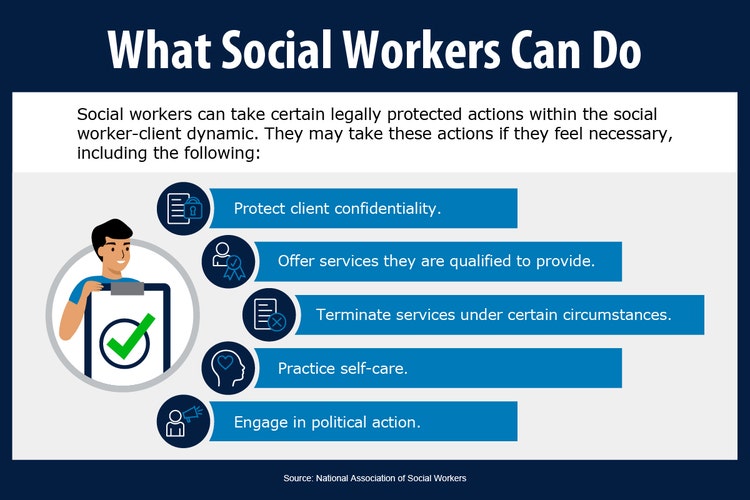
Social workers can take certain legally protected actions within the social worker-client dynamic, according to the National Association of Social Workers, including the following: Protect client confidentiality. Offer services they are qualified to provide. Terminate services under certain circumstances. Practice self-care. Engage in political action.
What Social Workers Can’t Do
The extent of what social workers can’t do includes various impermissible actions, as the examples below demonstrate.
Make Certain Physical Contact
Social workers can’t have physical contact with clients if the contact could cause the clients psychological harm. If social workers have permissible physical contact, they must set boundaries on what is appropriate, culturally sensitive and clear.
Use Derogatory Language
In their communications with or about their clients (including oral, electronic or written communications), social workers shouldn’t use derogatory language. Their language must be respectful and accurate.
Provide Services in Certain Cases Involving Conflict of Interest
Social workers should avoid conflicts of interest that could interfere with their impartial judgment and professional discretion. They need to inform clients regarding conflicts of interest and develop a resolution that protects clients’ interests. Some instances of conflict of interest may require the social worker to refer a client to another professional.
Permit Personal Issues to Impair Their Work
Social workers shouldn’t allow their personal issues (such as mental health concerns or misuse of substances) to jeopardize their clients’ best interests or impair their performance or judgment.
Engage in Discrimination
Social workers shouldn’t facilitate or condone any discrimination on the basis of age, color, ethnicity, gender identity or expression, immigration status, marital status, mental or physical ability, national origin, political belief, race, religion, sex, or sexual orientation.
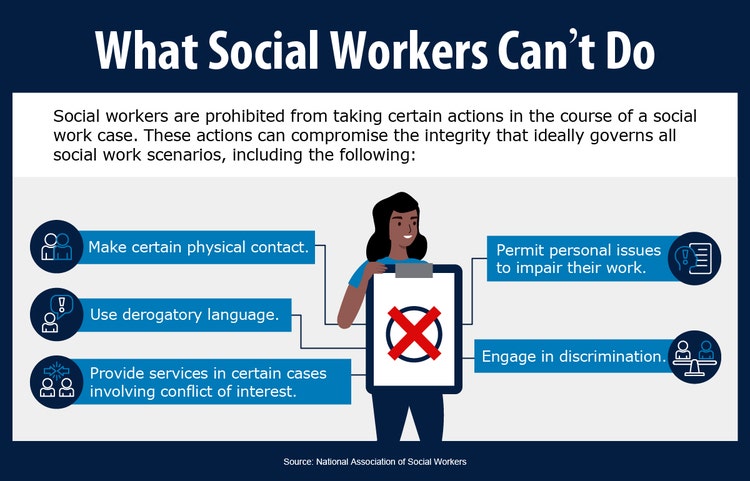
Social workers are prohibited from taking certain actions in the course of a social work case. These actions can compromise the integrity that ideally governs all social work scenarios, including the following: Make certain physical contact. Use derogatory language. Provide services in certain cases involving conflict of interest. Permit personal issues to impair their work. Engage in discrimination.
Additional Resources on Permissible and Impermissible Actions for Social Workers
- The following resources offer additional information related to what social workers are and are not permitted to do:
Administration for Community Living, Voluntary Consensus Guidelines for State APS Systems: This resource offers guidance for states in developing adult protective systems. - Association of Social Work Boards, Model Social Work Practice Act: This resource provides a model for best practices in the regulation of social work, including actions that social workers should and should not take.
- Child and Adolescent Social Work Journal, “African‑Centered Frameworks of Youth Development: Nuanced Implications for Guiding Social Work Practice With Black Youth”: This journal article offers specific insights regarding social workers who work with Black youth populations.
- Journal of Social Work in the Global Community, “Understanding Refugee Mental Health and Employment Issues: Implications for Social Work Practice”: This article provides recommendations for social workers working with resettled refugees.
- Journal of Technology in Human Services, “The Use of Facebook in Social Work Practice With Children and Families: Exploring Complexity in an Emerging Practice”: This study offers information regarding social workers’ use of Facebook in social work practice.
- National Conference of State Legislatures, Child Welfare Enacted Legislation: This resource enables individuals to search a database of enacted child welfare legislation in all 50 states, the District of Columbia and U.S. territories. This can help identify actions that are and are not permitted by law.
- U.S. Department of Health and Human Services, Child Protection Casework Practice: This resource offers content to guide Child Protective Services caseworkers in best practices.
Types of Social Work
Specific aspects of what social workers are permitted to do can vary based on the particular types of social work they practice. The examples below explain the various roles a social worker can play.
Child Welfare Social Worker
Social workers who specialize in child welfare help ensure that children have a safe living environment. This means that they sometimes need to make interventions to keep children from being harmed.
Health Care Social Worker
Health care social workers help ensure that individuals in the health care system have the resources they need (such as transportation and access to proper nutrition) to improve or maintain their health. They also take action to reduce health disparities.
Mental Health Care Social Worker
Clinical social workers assess, diagnose and treat individuals with mental illness. They typically provide group, family or individual therapy.
Substance Misuse Social Worker
When they work as substance misuse counselors, social workers help individuals struggling with addiction by developing treatment plans and supporting them as they try to change their behavior patterns.
Military Social Worker
Military social workers serve the unique needs of service members in areas such as mental health and the challenges of deployment. Both civilians and members of the armed forces can be military social workers.
Public Welfare Social Worker
Individuals who serve as public welfare social workers help connect vulnerable individuals with the support services and income programs necessary to fulfill their basic needs.
School Social Worker
School social work involves duties such as conducting counseling, providing crisis prevention services and coordinating with community agencies to improve students’ educational outcomes and emotional and social development.
Justice and Corrections Social Worker
Social workers in criminal justice specialize in working with those in the criminal justice system to provide counseling, and connect those released from prison with rehabilitative services and help them reenter society.
Occupational Social Worker
Occupational social workers provide job counseling and help organizations improve issues such as morale and productivity. They can also be employed by unions and work in union organizing.
Social Work Issues
The wide variety of social work issues offers numerous opportunities for social workers to apply their expertise. The actions that social workers are authorized to take can mitigate numerous issues, as the following examples illustrate:
Homelessness
Homelessness is a difficult challenge across the country. Nearly 600,000 people experienced homelessness in 2020, according to the latest data from the National Alliance to End Homelessness. Social workers can apply their expertise in tackling this issue by advocating for basic incomes for individuals and promoting programs to expand affordable housing.
Substance Misuse
From opioids and prescription medication to illegal drugs, substance misuse is an issue where the expertise of social workers can make a difference. Social workers can also offer services in related areas, such as treating mental health issues and helping individuals navigate the criminal justice system.
Domestic Violence
Domestic violence is a significant issue facing families across the country, and it often goes unreported. According to NASW, each year approximately 1 million women and 835,000 men are assaulted by an intimate partner. Social workers have significant expertise to support those who have experienced domestic violence, including providing counseling, assisting individuals living in shelters, and serving as victim advocates in the court system.
Mental Health
Demand for mental health treatment, particularly for depressive and anxiety disorders, is on the rise, according to the Centers for Disease Control and Prevention (CDC). Serving as mental health counselors, qualified and licensed social workers can play a significant role in helping to meet that demand.
Poverty
The increasing poverty rate is an issue that social workers can help address on both the micro and macro levels. Social workers can connect those living in poverty with basic services and resources, such as food and shelter; they can also advocate for programs to help alleviate poverty on a national scale.
Social Justice
Economic justice, racial discrimination, immigration reform, and criminal justice reform are just a few examples of social justice issues that social workers can focus on in their advocacy efforts and the work they perform in a range of social programs.
Additional Resources on Social Work Issues
The following resources offer additional information related to issues social workers confront in their practice:
- Asia Pacific Journal of Social Work and Development, “Rethinking Four Social Issues of the COVID-19 Pandemic from Social Work Perspectives”: This resource offers information on issues arising from the COVID-19 pandemic and related implications for social workers.
- International Social Work, “Environmental Social Work in the Disciplinary Literature, 1991–2015”: This journal article discusses pollution and climate change implications for social work.
- Journal of Human Rights and Social Work, “Human Rights-Based Social Work Practice With Immigrants and Asylum Seekers in a Legal Service Organization”: This article offers information about social workers who work with immigrants and asylum seekers.
- National Rural Health Association, “Is There a Shortage of Rural Social Workers?”: This article highlights the needs of rural areas and the issues that social workers confront when working in those areas.
- U.S. Department of Justice, “Embedded Police Social Workers”: This article discusses embedding social workers with police to address issues such as mental health concerns and homelessness.
Advancing Society Through Social Work Practice
Social workers are dedicated professionals who work each day to make progress in addressing critical issues that affect all our lives. What social workers do benefits not only the vulnerable individuals they serve but also society as a whole. The improvements that social workers have made over the years are a testament to their unwavering commitment to improving the lives of others.
Infographic Source:
https://www.socialworkers.org/About/Ethics/Code-of-Ethics/Code-of-Ethics-English