What Is The Average Salary With a MSW?
Licensed social workers play a pivotal role in their communities helping individuals and groups overcome challenging circumstances to improve their quality of life.
A career in social work can be rewarding, but it requires the right education if you hope to be as effective as possible. If you’re interested in becoming a licensed social worker and positively impacting your community, a Master of Social Work (MSW) might be the degree for you.
The University of Nevada, Reno wants to help you understand the benefits of earning your MSW, including answering a crucial question: How much do social workers make with a master’s degree? Below, we dive deeper into this question and explore how different specializations impact the average social worker’s salary.
How Much Do Social Workers Make with a Master’s Degree?
When pursuing an MSW, it’s helpful to consider the average social worker salary in the U.S. and how different specializations play a role in this number.
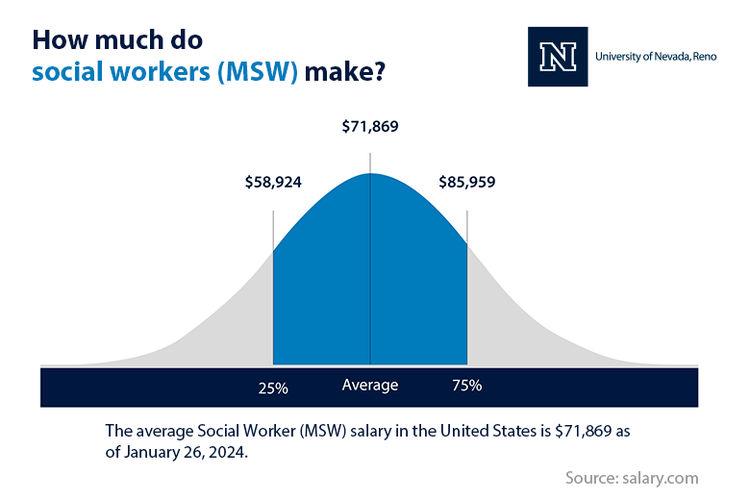
According to data compiled by the U.S. Bureau of Labor Statistics (BLS), the median salary for all social workers in the United States is about $58,000. However, data from online career resource Salary.com suggests that social workers who hold a Master of Social Work have a sizable advantage in terms of salary, with a median annual pay of around $72,000.
Many factors contribute to a social worker’s salary beyond education — including location, years of experience, and specific circumstances. Salary.com lists the expected range of salaries for MSW-educated social workers as between $65,000 and $79,000.
The specialization or industry in which you work also affects the salary you can expect. The BLS lists the following average salaries for social workers employed across a number of fields.
- Hospitals: $66, 300
- Local Government: $62,280
- Ambulatory Healthcare Services: $58,690
- State Government: $52,640
- Mental Health and Substance Abuse: $51,240
- Individual and Family Services: $46,670
Note that the salaries listed above don’t take education level into consideration, so in most cases, an MSW-prepared social worker stands to earn more. BLS data shows that the highest 10% of social workers earn at least $94,000, suggesting a high ceiling for those who pursue advanced education and higher-level career opportunities.
Factors that Impact a Social Worker’s Salary
Even though certain specializations and employment sectors can sway your salary, you can earn a livable wage with an MSW. But what other factors may influence your pay? There are many circumstantial and occupational considerations that may affect how much you earn. Here are a few examples.
Location of Practice
One of the biggest influences on a social worker’s salary is the location of practice. This has a strong correlation with standard cost of living, meaning social worker salaries tend to be higher in states in which cost of living is higher. Data from the BLS shows, on average, more opportunities and better pay in states like New York, California, Texas, Massachusetts and Washington, which are typically associated with higher cost of living.
However, high-paying opportunities exist in all states, and even some states with a relatively low cost of living can rank among the highest-paying locations for social workers in certain fields. For example, Kansas, Oklahoma, Alabama and Nevada — where the University of Nevada, Reno is based — all offer among the highest wages for some fields of social work.
Type of Practice
As discussed above, setting and field have a lot to do with how much a social worker can expect to earn. For example, BLS data shows that healthcare social workers earn a median salary of $62,000, with the 75th percentile earning at least $78,000 per year. On the lower end of the scale, child, family and school social workers earn a median salary of $53,000, with the top 25% earning at least $68,000.
The field and the location in which you practice are closely aligned in terms of how much you can expect to earn. For example, Utah and Oregon rank among the highest-paying states for healthcare social workers, according to BLS data, but are far less competitive for general practitioners or for social workers in other fields. Alabama, Kansas, South Dakota and Oklahoma rank in the top quartile for generalist social workers but tend to be in the lower half for other specializations.
Years of Experience
As social workers continue to practice, they will typically evolve and advance in their effectiveness and knowledge of their practice. This is due to experience on the job and the opportunities to pursue further education, such as certificates or a Master of Social Work.
According to the career and salary resource Payscale.com, entry-level social workers have an average salary of about $48,000 with typical earnings growing steadily with each year of experience:
- Entry level (less than 1 year): $48,000
- 1-4 years: $51,000
- 5-9 years: $57,000
- 10-19 years: $62,000
- 20 or more years: $64,000
These numbers are averages across social workers of all backgrounds and education levels. Pursuing an advanced education like an MSW can help you command higher salaries earlier in your career.
Negotiating Your Salary with an MSW
Negotiating your salary with an MSW can be challenging, but it can be crucial to getting paid what you’re worth to do this challenging but rewarding work. Here are a few things to consider when negotiating your salary — whether it’s for your first social worker job or your next step.
First, research the average social worker salary in your area and industry to see where you fit. The BLS is a good reference for this, as it can show you what social workers in your state and in your field of practice earn.
Next, consider your experience level. If you found a career as a social worker after earning your bachelor’s degree, you likely have plenty of real-world experience that can be crucial to providing top-level service to the community you serve. But even if you opted to continue your education and earn your MSW, your graduate education likely provided high-level theoretical and practical experience and training that add value to your resume.
Once you’re ready to negotiate, highlight your skills, experience and achievements while working in the field. Showing confidence in these discussions and knowing your bottom line is also helpful.
Get Your MSW Online to Advance Your Career and Salary
Pursuing your Master of Social Work can be worthwhile for many reasons, including performing better as a social worker, providing a higher level of service, and potentially commanding a higher salary throughout your career.
At the University of Nevada, Reno, we offer a convenient and flexible online MSW program to prepare you for a successful social work career. Learn more today about earning your online MSW today.
Sources
Salary.com, “Social Worker (MSW) Salary in the United States”
U.S. Bureau of Labor Statistics, “Child, Family, and School Social Workers”
U.S. Bureau of Labor Statistics, “Healthcare Social Workers”
U.S. Bureau of Labor Statistics, “Mental Health and Substance Abuse Social Workers”
U.S. Bureau of Labor Statistics, “Social Workers”
U.S. Bureau of Labor Statistics, “Social Workers, All Other”
U.S. News & World Report, “Cost of Living”